A Strategic Guide for Business Owners & Startups
Every year, businesses lose millions of dollars not because they lack a great product or service but because they fail to communicate their value clearly on paper. In 2026, the proposal has evolved from a simple document into a dynamic strategic instrument that can determine the success of your next contract, partnership, or investment.
Whether you are a bootstrapped startup pitching your first enterprise client or an established business expanding into new markets, mastering proposal writing and leveraging the right tools and templates is no longer optional. It has become a competitive necessity.
This guide explains the most effective proposal writing tools and templates available in 2026, what to look for, and how to build a system that consistently wins business.
Why Proposals Still Win Deals in 2026
Despite the rise of AI-generated content and automated outreach, the business proposal remains one of the most powerful touchpoints in the sales and partnership cycle. Decision makers, particularly at the enterprise level, still expect a well structured and tailored document that demonstrates you understand their challenges and have a credible plan to solve them.
What has changed in 2026 is the standard of quality. Prospects now receive AI polished proposals from competitors. This means the quality threshold has increased significantly. Generic and copy pasted proposals no longer impress. In fact, they often signal a lack of seriousness.
Your proposal must be:
• Tailored to the specific client and their known pain points
• Visually professional and easy to navigate
• Supported by data, case studies, or social proof
• Delivered through a seamless modern experience such as a PDF, an interactive web link, or both
The Anatomy of a Winning Business Proposal
Before exploring tools, it is important to understand what every effective proposal must contain. Although formats vary by industry, the following structure has proven consistently successful for B2B proposals.
1. Executive Summary
This is the most frequently read section and sometimes the only section reviewed by senior decision makers. Your executive summary should immediately communicate the problem you solve, your proposed approach, and the value you deliver. Keep this section to one page and write it after completing the rest of the proposal.
2. Problem Statement
Describe the client’s challenge clearly and insightfully. When you articulate their problem better than they can themselves, you establish credibility immediately. Use the client’s language, reference their industry context, and quantify the cost of the problem whenever possible.
3. Proposed Solution
Explain your approach clearly and concisely. Avoid unnecessary jargon and focus on practical outcomes. Visual elements such as timelines, workflow diagrams, or phased rollout plans can help make your solution easier to understand.
4. Deliverables and Scope
Specificity is essential here. Vague proposals often create expectation mismatches that damage trust later. Clearly define what you will deliver, when it will be delivered, and what is not included. This clarity also protects your business from scope creep.
5. Pricing and Investment
Position your pricing as an investment rather than an expense. Tiered pricing options such as Good, Better, and Best often perform better than a single price because they provide prospects with a sense of choice. Always establish value before presenting pricing details.
6. Social Proof and Case Studies
A proposal without evidence is simply a promise. Include at least one relevant case study, testimonial, or measurable result that demonstrates your success in similar situations. Whenever possible, match the proof to the prospect’s industry or company size.
7. Terms and Next Steps
Finish with a clear call to action. Explain what happens after the client accepts the proposal. Provide a simple next step such as a signature line, a kickoff meeting link, or a confirmation button. Reducing friction at this stage significantly increases the likelihood of closing the deal.
Top Proposal Writing Tools for 2026
The proposal software ecosystem has matured considerably. Business owners and startups can now choose from several categories of tools depending on their scale, proposal volume, and deal complexity.
Proposal Platforms
These platforms combine proposal creation, electronic signatures, and analytics in a single workflow.
PandaDoc
An industry leading platform that includes a robust template library, CRM integrations, and real time proposal analytics. It is especially suitable for startups that are building a scalable sales process.
Proposify
Known for its strong focus on design quality and brand consistency. It is an excellent choice for agencies and service businesses that rely on visual storytelling.
Better Proposals
A streamlined and cost effective solution designed for fast moving small businesses and consultants who send proposals frequently.
AI Proposal Tools
Artificial intelligence has become a powerful support tool for proposal writing. When used correctly, these platforms can significantly reduce the time required to produce a strong first draft.
Claude
Highly effective for drafting detailed executive summaries, restructuring arguments, and adjusting tone for specific industries.
ChatGPT
Commonly used for generating initial proposal drafts, refining language, and testing different approaches to pricing explanations.
Jasper
A marketing focused AI writing platform with templates that work particularly well for product driven companies developing detailed solution narratives.
Design and Visual Proposal Tools
Visual presentation plays a critical role in shaping a prospect’s first impression.
Canva
Provides an extensive library of proposal templates with an intuitive drag and drop editor. It allows founders to produce professional designs without needing a dedicated design team.
Visme
Especially useful for data heavy proposals that require charts, infographics, and visual storytelling elements.
Adobe Express
Offers sleek templates that help businesses maintain consistent visual branding across all client facing materials.
Essential Proposal Templates for Business Owners
Different business situations require different proposal formats. The following five templates form the foundation of a strong proposal system.
Template 1: The Service Proposal
Best suited for agencies, consultants, and professional service firms.
Structure: Executive Summary → Client Challenges → Your Approach → Deliverables → Timeline → Investment → Team Biography → Terms.
This template should highlight expertise, methodology, and the value behind your pricing.
Template 2: The Product Proposal
Best for software companies, hardware vendors, and product focused startups.
Structure: Problem Statement → Product Solution Overview → Key Features and Benefits → Integration Details → Pricing Tiers → Implementation Plan → Support Model → Next Steps.
Product screenshots or demonstration links strengthen this format.
Template 3: The Partnership Proposal
Designed for strategic alliances, distribution partnerships, and co marketing collaborations.
Structure: About the Organization → Shared Market Opportunity → Partnership Value Proposition → Proposed Structure → Revenue Model → Mutual Commitments → Timeline.
The tone should emphasize collaboration rather than a purely transactional relationship.
Template 4: The Investment Proposal
Used by startups seeking capital from angel investors, venture capital firms, or strategic investors.
Structure: Problem and Market Opportunity → Solution → Business Model → Traction and Metrics → Team → Use of Funds → Financial Projections → Exit Strategy.
Investors typically review large volumes of proposals, so clarity and brevity are essential.
Template 5: The Grant Proposal
Appropriate for organizations applying for government funding, research grants, or nonprofit support programs.
Structure: Organization Overview → Project Description → Objectives and Outcomes → Methodology → Budget Breakdown → Evaluation Plan → Team Credentials.
These proposals are reviewed carefully, so budgets and performance metrics must be precise.
Building a Repeatable Proposal System
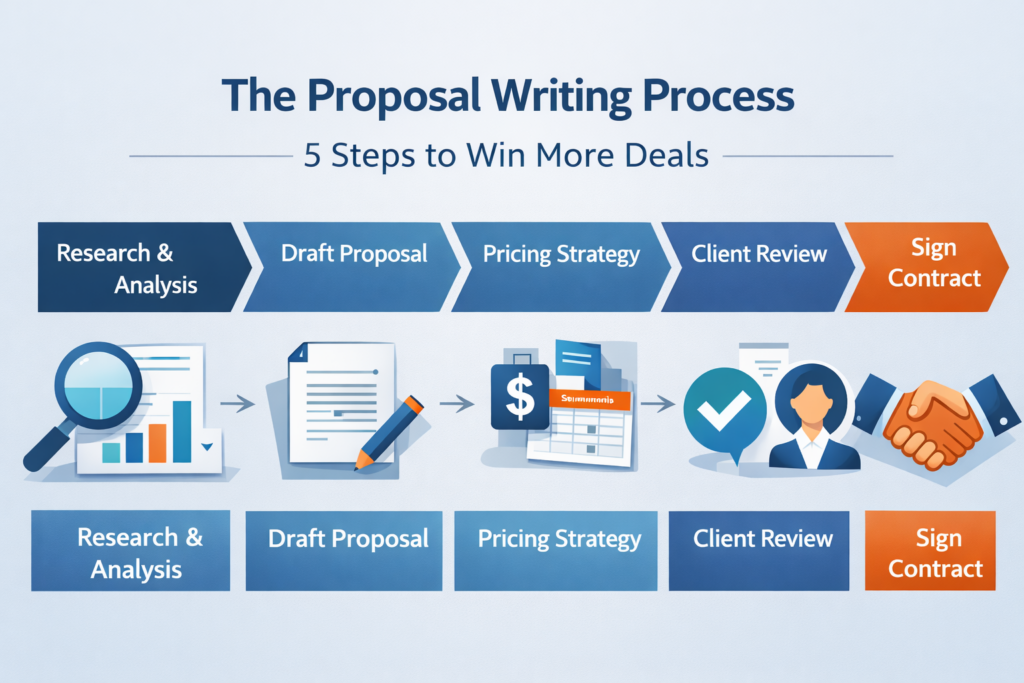
The most successful companies do not create proposals from scratch every time. Instead, they establish a repeatable process that maintains quality while reducing preparation time.
1. Create a Master Content Library
Develop a central repository that contains reusable sections such as company overviews, team biographies, case studies, service descriptions, and pricing options. Review and update this library quarterly.
2. Develop Three to Five Core Templates
Create templates that reflect your most common proposal types. These templates should be fully designed and require only minimal customization for each client.
3. Standardize the Review Process
Each proposal should go through at least one review focused on clarity, proofreading, and alignment with the client’s needs before it is sent.
4. Track Proposal Performance
Use proposal software analytics to monitor open rates, time spent reading each section, and overall win or loss rates. These insights can guide improvements over time.
5. Analyze Lost Deals
When a proposal is declined, request feedback from the prospect. Even brief responses can reveal valuable insights that no analytics dashboard can provide.
Common Proposal Mistakes
Even experienced business owners make avoidable mistakes that weaken their proposals.
Listing features instead of outcomes
Clients purchase results, not features. Frame every capability in terms of the outcome it produces for the client.
Sending identical proposals to every prospect
Personalization is essential. Reference the client’s context, goals, or recent developments to demonstrate genuine understanding.
Ignoring visual presentation
A poorly formatted proposal damages credibility regardless of the quality of the content. Professional design reflects professionalism.
Hiding the pricing structure
Many prospects immediately look for pricing. Present it clearly and pair it with strong value explanations.
Failing to follow up
Sending a proposal without a follow up plan reduces your chances of closing. Implement a simple sequence such as follow ups at 48 hours, five days, and ten days after delivery.
Conclusion
The Proposal as a Competitive Advantage
In 2026, the companies that secure the most valuable contracts, partnerships, and investments are not always the ones with the best product. They are the ones that communicate their value most effectively and consistently.
By adopting modern proposal writing tools, building a library of tailored templates, and establishing a disciplined review and follow up process, proposals can evolve from a time consuming task into a dependable growth engine.
The tools and templates described in this guide provide a strong foundation. Ultimately, the true differentiator is the strategic thinking behind each proposal. Understand your client deeply, present your value clearly, and deliver a proposal experience that makes saying yes feel natural and easy.
Ready to Elevate Your Proposal Game?
Start by reviewing your last five proposals. Identify the section that most consistently needs improvement, then build your first reusable template block around strengthening that section.