Introduction
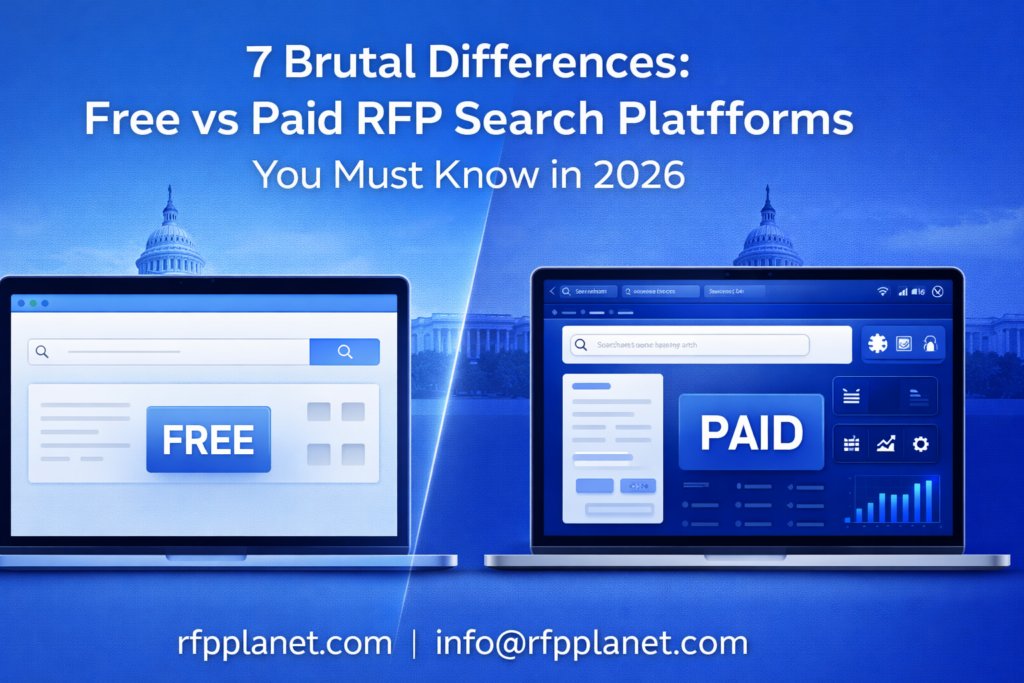
Free vs paid RFP search platforms is one of the most common questions businesses ask when they first start pursuing government contracts. Should you spend hours manually searching free government portals, or is it worth paying for a premium platform that does the work for you?
The honest answer depends on your business size, how often you bid, and how seriously you want to grow your government contract revenue. But before you decide, you need to understand the real differences between free vs paid RFP search platforms because there are 7 critical ones that most businesses overlook completely.
In this complete 2026 pillar guide, we break down every major difference between free and paid options, compare the top platforms currently available, and help you make the smartest decision for your business. Whether you are a solo consultant just starting out or a mid-size company with a dedicated business development team, understanding the free vs paid RFP search platform landscape will save you time, money, and missed opportunities.
Let us dive in.
What Are Free vs Paid RFP Search Platforms?
Before comparing them, it helps to understand exactly what each type of platform offers.
Free RFP search platforms are government-run or community-maintained portals where agencies publish their procurement notices at no cost to vendors. The most well-known examples include SAM.gov for federal contracts, individual state procurement portals, and county or municipal websites. These platforms publish the official RFP documents and are the primary source for all government bid data.
Paid RFP search platforms are private companies that aggregate, organize, and enrich RFP data from hundreds of government sources into a single searchable database. These platforms aggregate links to RFPs, RFQs, tenders, and other bid solicitations posted on public sector websites, allowing businesses to search dozens of government websites at once based on saved search criteria.
The core question in the free vs paid RFP search platforms debate is not which one has the data. It is which one helps you use that data most effectively to win more contracts.
Difference #1: Coverage and Number of RFPs Listed
This is the most important difference when evaluating free vs paid RFP search platforms.
Free platforms like SAM.gov only cover federal government contracts. To find state, county, and local government RFPs, you would need to visit each state procurement portal separately. That means checking 50+ different websites every single day just to stay current.
Paid platforms aggregate RFPs from federal, state, county, local, and sometimes international sources into one single database. Leading paid platforms find government bids and contracts from over 110,000 government agencies, including US federal, state, cities, counties, and schools. RFPPlanet covers all 50 US states and Canada, pulling thousands of active opportunities into one searchable interface updated daily.
| Coverage | Free Platforms | Paid Platforms |
|---|---|---|
| Federal RFPs | Yes | Yes |
| All 50 US States | Manual only | Aggregated |
| Local / County RFPs | Very limited | Included |
| Canada | No | Yes |
| Daily updates | Partial | Yes |
Verdict: Paid platforms win on coverage significantly. If you only bid on federal contracts, SAM.gov may be enough. For state and local opportunities, a paid aggregator is essential.
Difference #2: How Fast New RFPs Are Added
Speed matters enormously in government contracting. Many RFPs have submission windows of just 2 to 3 weeks. If you find out about an opportunity 10 days late, you may not have enough time to write a competitive proposal.
Free platforms post RFPs as soon as agencies publish them, but you have to check manually every day. There is no automated discovery unless you set up basic keyword alerts on SAM.gov, which are limited in customization and coverage.
Paid platforms run automated crawlers that continuously scan government portals and update their databases daily, sometimes within hours of a new posting. Paid aggregators are updated daily to ensure that you receive the most accurate and up-to-date information available, so businesses can find and win local, county, state, and federal government contracts without missing new postings.
Premium platforms take this further with AI-powered matching that sends you only relevant results based on your industry and location profile.
Verdict: Both can be fast, but paid platforms automate the discovery process so you never miss a posting even when you are busy running your business.
Difference #3: Search and Filter Capabilities
This is where free vs paid RFP search platforms differ most dramatically in daily usability.
Free platforms like SAM.gov offer basic keyword and NAICS code search. The interface is functional but clunky, and filtering by multiple criteria simultaneously such as location, category, budget, and deadline is difficult and time-consuming.
Paid platforms offer advanced multi-parameter filtering. On RFPPlanet, for example, you can simultaneously filter by industry category, country, state or province, notice type, budget range, deadline window, contract term length, and organization type.
The biggest change in 2026 is the rise of AI-powered platforms. Traditional tools like SAM.gov rely on keyword-based search and manual filtering, while AI-native platforms now offer natural language search, AI-generated RFP summaries, and automated matching that fundamentally changes how contractors discover and pursue opportunities.
Verdict: Paid platforms are dramatically better for search and filtering, saving hours of manual work every week.
Difference #4: Email Alerts and Notifications
In the free vs paid RFP search platforms comparison, email alerts are one of the most underrated features that separate the two types.
Free platforms offer limited alert functionality. SAM.gov allows basic saved searches with email notifications, but alerts are generic and often include irrelevant results. Customization options are minimal at best.
Paid platforms offer intelligent, customizable alerts built around your specific business profile. You can set alerts by category, state, budget range, and keywords, then choose daily or weekly digest delivery. RFPPlanet’s free email alert system, for example, matches new RFPs to your criteria and delivers a clean digest to your inbox on a schedule you choose.
The difference in practical terms is significant. Instead of spending 30 to 60 minutes per day checking multiple portals, your morning email contains a curated list of relevant opportunities that are ready to review immediately.
Verdict: Paid platforms win decisively on alerts. Intelligent notifications are one of the single biggest time-savers available to government contractors today.
Difference #5: Quality of RFP Data and Details
When comparing free vs paid RFP search platforms, data quality directly impacts how effectively you can evaluate and pursue opportunities.
Free platforms show the raw RFP document as published by the agency. You get the official text but no enrichment, no estimated budget, no contract history, no agency spending patterns, and no incumbent information.
Paid platforms enrich RFP listings with additional context such as:
- Estimated contract value
- Deadline prominently displayed
- Direct link to original source documents
- Category classification for easy browsing
- Related amendments and updates
- Agency contact information
The enriched data helps you quickly evaluate whether an opportunity is worth pursuing before investing any proposal writing time.
For companies involved in frequent RFP responses, specialized platforms offer the most targeted solution, ensuring that responses are not only well-written but also compliant and optimized for the highest chance of success.
Verdict: Paid platforms provide richer, more actionable data that helps you make faster go or no-go decisions on each opportunity.
Difference #6: Customer Support
This difference in the free vs paid RFP search platforms debate is rarely discussed but critically important for businesses new to government contracting.
Free platforms like SAM.gov offer government-style support including online help documentation, FAQ pages, and contact forms with multi-day response times. There is no dedicated account manager or live chat to help you navigate the system or optimize your searches.
Paid platforms typically offer dedicated customer support including live chat, email support, onboarding assistance, and in some cases dedicated account managers who help you configure your search settings and alert criteria. For businesses new to government contracting, this guidance can be the difference between finding great opportunities and getting completely lost in the system.
Verdict: Paid platforms offer significantly better support, which is especially valuable for businesses entering the government contracting market for the first time.
Difference #7: Cost vs Return on Investment
The final and most important factor in the free vs paid RFP search platforms comparison is total ROI when all costs are factored in honestly.
Free platforms cost nothing in subscription fees, but they cost you significant time. Manually searching multiple government portals daily can consume 1 to 3 hours per day for a dedicated staff member. At an average US salary of $25 per hour, that is $500 to $1,500 per month in labor costs just for RFP discovery alone.
Paid platforms charge monthly or annual subscription fees ranging from $50 to $500 per month depending on features and coverage. The ROI calculation is straightforward. If a paid platform helps you find and win even one additional government contract per year, it pays for itself many times over since government contracts typically range from $25,000 to $500,000 or more.
| Cost Factor | Free Platforms | Paid Platforms |
|---|---|---|
| Subscription fee | $0 | $50 to $500 per month |
| Staff time for daily search | 1 to 3 hours per day | 15 to 30 minutes per day |
| Estimated monthly labor cost | $500 to $1,500 | $100 to $200 |
| Total monthly cost | $500 to $1,500 | $150 to $700 |
| Opportunities missed | High | Low |
Verdict: Free platforms are not actually free when you factor in staff time honestly. Paid platforms often deliver better total ROI even after accounting for subscription costs.
Top Free RFP Search Platforms in 2026
Here are the best free options currently available for finding government RFPs in the USA:
1. SAM.gov – Best Free Federal Platform
👉 sam.gov
The official US federal procurement database. All federal RFPs are published here first. Free to search and free to register. SAM.gov registration is free but required for federal contracting, and its advanced contract search and downloadable award data can uncover bid opportunities across all federal agencies. Best for federal contracts only.
2. State Procurement Portals
Every US state runs its own free procurement portal. Key examples include:
- California: caleprocure.ca.gov
- Texas: txsmartbuy.gov
- New York: ogs.ny.gov
- Florida: myfloridamarketplace.myflorida.com
Best for state-specific opportunities. Limitation: you must check each state portal separately every day.
3. USASpending.gov
Not an RFP search tool, but invaluable for researching past contract awards, agency spending patterns, and identifying which agencies buy what you sell. Completely free and highly useful for market research.
4. SBA SubNet
The Small Business Administration’s subcontracting opportunities database. Free and specifically designed for small businesses looking for subcontracting work under large prime contractors.
5. RFP Database
A database for government, for-profit, and non-profit requests for proposals without any subscription or membership fees. A useful supplementary free resource for finding additional RFP listings.
Top Paid RFP Search Platforms in 2026
Here are the leading paid aggregator platforms for government RFP search currently available:
1. RFPPlanet – Best Value in 2026
AI-powered RFP search covering all 50 US states and Canada. Free email alerts, advanced filtering, 60+ industry categories, and daily updates. Currently free during beta, making it the best value option available today. Browse active RFPs on RFPPlanet or view all RFP categories.
2. BidNet Direct
BidNet Direct offers businesses a centralized location to gain instant access to bid opportunities from state departments, local municipalities, and the federal government, with email alerts to matched opportunities by category and location. Strong coverage of municipal and county-level RFPs.
3. DemandStar
A popular platform for state and local government RFPs. Offers free basic access with paid premium tiers for enhanced features and full document downloads. Good for businesses focused on state-level procurement.
4. BidPrime
BidPrime covers government bids and contracts from over 110,000 government agencies including US federal, state, cities, counties, and schools, making it one of the most comprehensive paid aggregators for broad coverage.
5. FindRFP
FindRFP provides a government RFP database covering new government bids, contracts, and requests for proposals from federal, state, and local governments with a free trial available.
Which One Should You Use?
The answer to the free vs paid RFP search platforms question depends entirely on your specific situation and business goals.
Use free platforms if you:
- Are just starting out and testing government contracting for the first time
- Only bid on federal contracts where SAM.gov covers everything you need
- Have dedicated staff with time available to search manually every single day
- Are working with an extremely tight budget and cannot justify any subscription cost
Use paid platforms if you:
- Bid on state and local opportunities in addition to federal contracts
- Want to save 1 to 2 hours of manual searching every day
- Cannot afford to miss time-sensitive opportunities with short submission windows
- Want email alerts that automatically match new RFPs to your specific business profile
- Are serious about growing your government contract revenue consistently
The smartest approach: Start with free platforms to learn the landscape and understand how government procurement works. Then upgrade to a paid aggregator once you are actively bidding on multiple opportunities. The time savings alone typically justify the subscription cost within the first month of active use.
How RFPPlanet Bridges the Gap
RFPPlanet was built specifically to solve the biggest frustrations with both free and paid RFP search platforms:
- Free to use during beta, with no credit card required to browse and set up alerts
- Comprehensive coverage of all 50 US states and Canada, updated daily
- AI-powered search that lets you type what your business does and find matching RFPs instantly
- Smart email alerts with daily or weekly digests matched to your category and location preferences
- Over 60 industry categories covering everything from IT and cybersecurity to healthcare and construction
- Advanced filters by state, budget, deadline, notice type, and contract term length
Start searching today:
- Browse all active government RFPs
- Set up your free email alert
- View all RFP categories
- See pricing and subscription plans
Conclusion {#conclusion}
The free vs paid RFP search platforms debate does not have a single right answer for every business, but the data strongly favors paid aggregators for any company serious about winning government contracts consistently and at scale.
Free platforms like SAM.gov are essential starting points and should always be part of your toolkit. But their limited coverage, manual search requirements, and basic alert systems make them insufficient as your only tool when you are actively competing for government contracts.
The smartest strategy is to combine both approaches. Use SAM.gov for federal opportunities and a paid aggregator like RFPPlanet for comprehensive coverage across all 50 states, Canada, and local government bids.
Start today by browsing open opportunities on RFPPlanet and setting up your free email alert so the free vs paid RFP search platform decision you make today is the one that gets your business in front of the right opportunities every single day in 2026.
Published by RFPPlanet – AI-powered government RFP and bid search for the USA and Canada. Updated March 2026.