Introduction
The RFP submission process is the foundation of winning government RFPs and other competitive procurement opportunities. A strong proposal is not just about writing well. It is about understanding the buyer’s needs, following the instructions exactly, and submitting a complete response before the deadline.
For vendors, consultants, and contractors, the RFP submission process can feel complex because every government RFP may have different requirements, formats, and evaluation criteria. That is why many businesses use RFPPlanet to discover government RFPs, track bids, and manage proposal opportunities more efficiently.
If your goal is to win more government RFPs, you need a repeatable system. You need the right opportunity, the right proposal structure, and the right compliance check before submission. That is where a focused RFP submission process creates a real advantage.
What Is the RFP Submission Process?
The RFP submission process is the series of steps a vendor follows to respond to a Request for Proposal. It begins with finding the right government RFP and ends when the completed proposal is delivered to the buyer through the correct channel.
A typical RFP submission process includes reviewing the solicitation, preparing the proposal, collecting supporting documents, checking compliance, and submitting the final package on time. Government agencies use this process to evaluate vendors based on experience, technical capability, pricing, and compliance.
When you follow a structured RFP submission process, you reduce mistakes, improve proposal quality, and increase your chances of winning government RFPs.
Why Government RFPs Require a Strong Submission Process
Government RFPs are highly structured and often strict. A missing form, incorrect file format, or late submission can cause a proposal to be rejected even if the content is strong. That is why the RFP submission process matters so much for government RFPs.
Unlike casual sales conversations, government RFPs require formal responses. Every instruction in the RFP must be followed carefully. The buyer is not only reviewing your solution but also checking whether you can follow procurement rules and submit a compliant proposal.
Using RFPPlanet helps businesses stay ahead in this process by making government RFPs easier to find, review, and track. When you know which opportunities matter, you can spend more time improving the proposal and less time searching for the next bid.
Step 1: Find the Right Government RFPs
The first step in the RFP submission process is finding the right government RFPs to pursue. Not every opportunity is worth bidding on, and a strong bid strategy starts with selecting proposals that match your services, experience, and capacity.
If you rely on manual searching, you may spend hours checking different procurement websites. RFPPlanet simplifies this by helping you discover government RFPs, bids, tenders, and contract opportunities in one place. That makes it easier to focus on relevant opportunities instead of wasting time on poor-fit bids.
A smart government RFP search strategy should consider:
- Your core services.
- Your previous experience.
- Required certifications.
- Bid deadline.
- Contract value.
- Delivery location.
- Competition level.
When the opportunity is a strong fit, the RFP submission process becomes much more effective.
Useful outbound resources for this stage include:
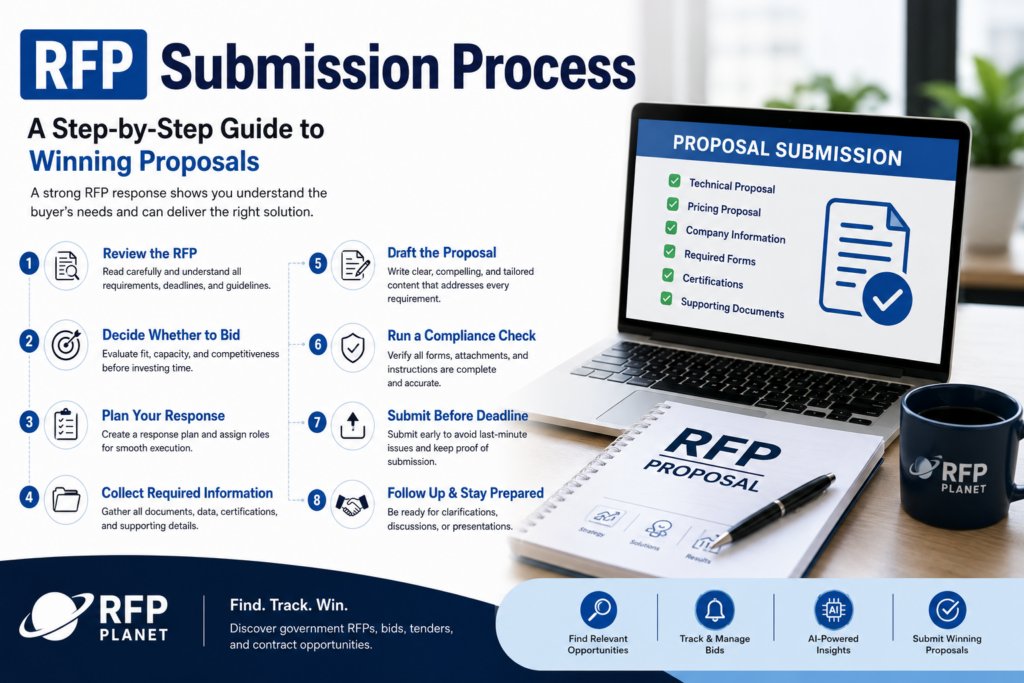
Step 2: Review the RFP Carefully
Once you find a suitable government RFP, the next part of the RFP submission process is reading the solicitation in full. This step is essential because government RFPs often contain detailed instructions about formatting, required documents, and submission methods.
Pay close attention to:
- Scope of work.
- Eligibility requirements.
- Proposal structure.
- Mandatory forms.
- Submission deadline.
- Evaluation criteria.
- Pricing instructions.
- Questions-and-answers rules.
A careful review helps you avoid common mistakes in the RFP submission process. It also helps you understand what the buyer values most, which lets you build a stronger, more relevant proposal.
Step 3: Decide Whether to Bid
A successful RFP submission process starts with a smart bid/no-bid decision. Many businesses make the mistake of chasing every government RFP they find, but this usually leads to wasted time and weaker proposals.
Before you commit, ask whether the government RFP matches your:
- Services.
- Team capacity.
- Experience.
- Budget range.
- Compliance readiness.
- Delivery timeline.
- Geographic coverage.
This decision is important because government RFPs often demand specialized qualifications or strict documentation. If your company is not a strong fit, it may be better to move on and focus on a better opportunity through RFPPlanet.
Step 4: Build a Proposal Plan
A disciplined RFP submission process needs a clear proposal plan. Once you decide to bid, assign responsibilities to the right people and create a submission timeline.
Your proposal team may include:
- Proposal writer.
- Technical lead.
- Pricing owner.
- Compliance reviewer.
- Final approver.
- Submission coordinator.
For government RFPs, a proposal plan is especially important because deadlines are firm and compliance checks are strict. A strong internal process helps keep everyone accountable and ensures the response is completed on time.
Many teams also use RFPPlanet to monitor opportunities and keep their bid workflow organized. When the right government RFP appears, your team can move faster because the process is already in place.
Step 5: Gather the Information Needed for Government RFPs
The next part of the RFP submission process is collecting the information needed to build a complete response. Most government RFPs ask for a standard set of company and proposal details.
Typical information includes:
- Company profile.
- Executive summary.
- Technical solution.
- Project timeline.
- Team qualifications.
- Relevant experience.
- References.
- Pricing.
- Required certifications.
- Signed declarations.
- Compliance forms.
Some government RFPs may also ask for insurance documents, financial statements, licenses, or tax-related forms. Gathering everything early keeps the RFP submission process smooth and helps avoid last-minute delays.
Step 6: Write a Tailored Proposal
A winning RFP submission process depends on a tailored proposal. Generic language does not work well for government RFPs because evaluators want direct answers, specific proof, and clear alignment with their requirements.
Your proposal should usually include:
Executive Summary
Explain your understanding of the project, why your company is qualified, and what value you will provide.
Technical Proposal
Describe your methodology, deliverables, implementation plan, quality assurance, and risk management.
Company Experience
Highlight similar work, government RFP experience, client references, certifications, and case studies.
Pricing
Provide pricing exactly as requested in the solicitation. Do not change the format unless the RFP allows it.
Supporting Documents
Attach all required forms, signatures, declarations, and compliance items.
When you write with government RFPs in mind, your proposal becomes easier to review and easier to score. That is one of the main goals of the RFP submission process.
Step 7: Run a Compliance Check
Compliance is one of the most important parts of the RFP submission process. A proposal may be rejected for reasons that have nothing to do with your solution, such as a missing signature, incorrect file format, or late delivery.
Before submission, check:
- Every question has been answered.
- All attachments are included.
- Required signatures are present.
- File names match instructions.
- Page limits are respected.
- Pricing is complete and accurate.
- The submission method is correct.
This step is especially important for government RFPs because procurement teams often enforce the rules strictly. If the proposal is non-compliant, it may not even reach the evaluation stage.
This is also where RFPPlanet can add value by helping users stay organized and track opportunities more effectively throughout the RFP submission process.
Step 8: Submit on Time
The final step in the RFP submission process is submitting the proposal before the deadline. Government RFPs often have firm cutoffs, and late responses are usually rejected automatically.
Proposals may need to be submitted through:
- Procurement portals.
- Email.
- Vendor systems.
- Physical delivery.
- Sealed bid instructions.
Do not wait until the last minute. Upload early, confirm the file opens correctly, and save proof of submission. A late or incomplete upload can cancel all the effort you put into the proposal.
What Information Should a Government RFP Proposal Include?
A complete proposal for government RFPs usually includes:
- Executive summary.
- Company profile.
- Understanding of the requirements.
- Technical solution.
- Project timeline.
- Team members.
- Relevant experience.
- Case studies.
- References.
- Pricing.
- Certifications.
- Signed forms.
- Insurance documents, if required.
Each section should answer the buyer’s questions directly. A strong RFP submission process makes sure every section supports the overall value of your proposal.
Common Reasons Government RFPs Are Rejected
Even strong proposals fail when the RFP submission process is not followed carefully. The most common reasons government RFPs are rejected include:
- Missing mandatory forms.
- Late submission.
- Wrong file format.
- Incomplete pricing.
- Ignoring instructions.
- Generic responses.
- Missing signatures.
- Failure to address evaluation criteria.
A clean, complete, and compliant proposal always performs better than a rushed response. That is why teams that work regularly with government RFPs build a repeatable review process before every submission.
How RFPPlanet Supports the RFP Submission Process
RFPPlanet helps businesses improve the RFP submission process by making it easier to find and track government RFPs. Instead of searching multiple websites manually, you can discover relevant bids, tenders, and contract opportunities in one platform.
RFPPlanet also supports proposal preparation through tools such as:
- Smart Search.
- Custom Bid Alerts.
- Saved Searches.
- Opportunity Tracking.
These tools help you spend more time preparing better proposals and less time managing manual searches. For businesses focused on government RFPs, that efficiency can make a big difference.
Useful RFPPlanet Resources
- RFPPlanet Homepage
- RFPPlanet Blog
- Government RFP Guide
- RFP Categories
- RFPPlanet Pricing
- Create a Free Account
FAQ
What is the RFP submission process?
The RFP submission process is the set of steps used to prepare, review, and submit a proposal in response to an RFP. It includes reviewing requirements, drafting the response, checking compliance, and submitting all required documents before the deadline.
What documents are usually required in government RFPs?
Government RFPs usually require a company profile, technical proposal, pricing, references, team qualifications, certifications, signed declarations, and compliance forms.
Why are RFP proposals rejected?
RFP proposals are often rejected because of late submission, missing documents, incorrect pricing, failure to follow instructions, or non-compliance with mandatory requirements.
How does RFPPlanet help with government RFPs?
RFPPlanet helps users find government RFPs, track bids, and manage the proposal workflow through AI-powered search, alerts, and compliance support.
Can AI improve the RFP submission process?
Yes. AI can help summarize RFPs, highlight requirements, organize proposal content, and identify missing items before submission.
Conclusion
A successful RFP submission process is built on preparation, compliance, and timing. When you focus on the right government RFPs, review the requirements carefully, build a tailored proposal, and submit before the deadline, you improve your chances of winning.
For teams that want to move faster and stay organized, RFPPlanet is a practical way to discover more government RFPs, manage opportunities, and simplify the proposal workflow.
Explore government RFPs with RFPPlanet: https://www.rfpplanet.com/