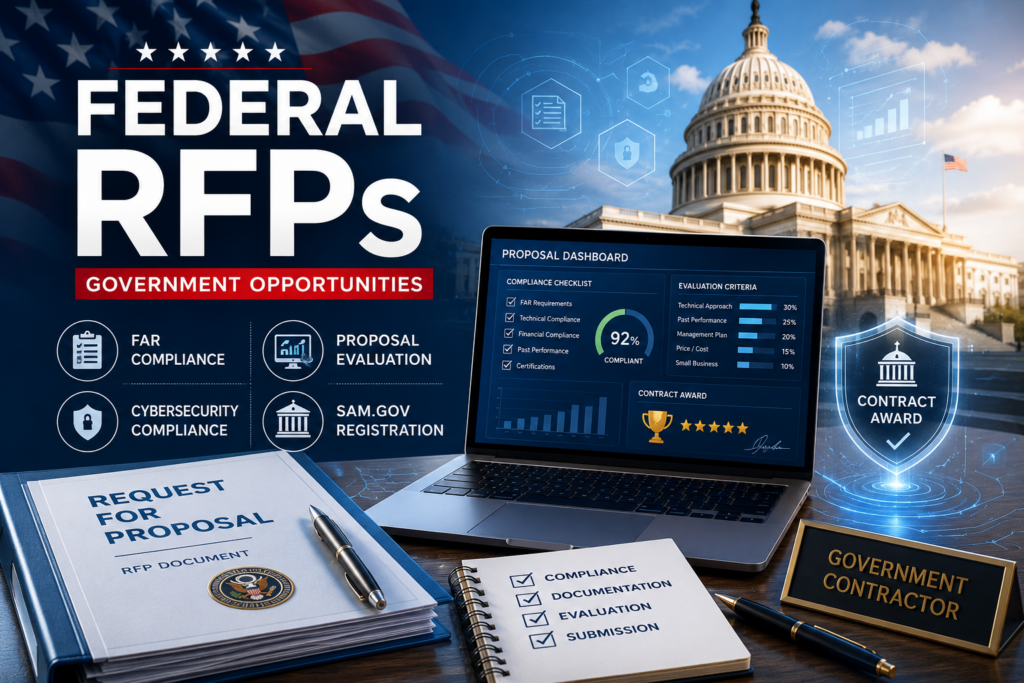
Everything you need to know about Federal RFP is, where to find government RFPs, how to submit proposals, required documentation, FAR compliance rules, and structured evaluation criteria for 2026 federal contracting success.
What is a Federal RFP?
A Federal RFP (Request for Proposal) is an official procurement document issued by U.S. federal government agencies to invite vendors, contractors, consultants, and service providers to submit proposals for government projects.
Federal RFPs are used when agencies require detailed technical solutions, pricing structures, qualifications, timelines, and compliance documentation before awarding a government contract.
In 2026, federal contracting continues to expand across industries including:
- Information Technology
- Cybersecurity
- Construction
- Healthcare
- Defense
- AI & Data Analytics
- Professional Services
- Marketing & Communications
- Staffing & HR
- Transportation & Infrastructure
Government agencies use structured procurement processes governed primarily by the Federal Acquisition Regulation (FAR) to ensure transparency, fairness, and compliance.
Where to Find Federal RFPs in 2026
The primary source for federal government opportunities is:
Many vendors also use specialized RFP aggregation and bid intelligence platforms such as:
Types of Federal Solicitation Documents
Federal agencies may issue:
| Solicitation Type | Strategic Purpose & 2026 Rule Relevance |
|---|---|
| RFP (Request for Proposal) | Solicits highly detailed solutions evaluated via Best Value Tradeoffs and price realism under tightened timelines. |
| RFQ / IFB | Request for quotes/bids; traditionally used for commercial goods, strictly monitored for automated compliance checking. |
| Sources Sought / RFI | Determines small business set-asides via the “Rule of Two.” Mandatory to respond early to influence RFP structure. |
| IDIQ / BPA / GWAC | Indefinite contract vehicles; heavily favored by agencies in 2026 for rapid, decentralized task order purchasing. |
How Federal RFPs Work
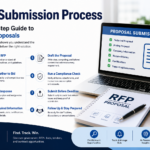
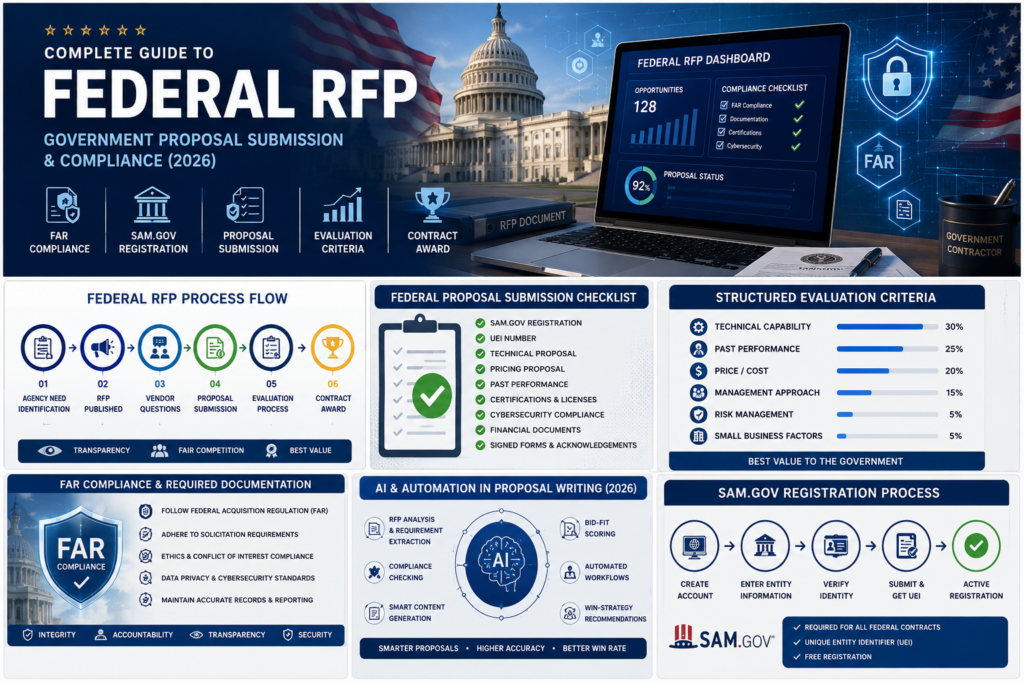
The federal procurement lifecycle generally follows these stages:
1. Agency Requirement Identification
The government agency identifies a need for products or services.
2. Solicitation Publication
The agency publishes the RFP on platforms such as SAM.gov.
3. Vendor Questions Period
Interested vendors can submit clarification questions.
4. Proposal Submission
Contractors submit technical and pricing proposals before the deadline.
5. Evaluation Process
The government evaluates proposals using predefined scoring criteria.
6. Contract Award
The agency awards the contract to the selected vendor.
7. Contract Performance
The awarded contractor delivers services/products according to contractual obligations.
Federal RFP Submission Requirements in 2026
Submitting a federal proposal requires strict adherence to compliance requirements.
Mandatory Registrations
Before bidding on federal contracts, businesses typically need:
1. Unique Entity Identifier (UEI)
Required for all federal contractors.
2. SAM Registration
Active registration on:
3. NAICS Codes
Businesses must select relevant North American Industry Classification System codes.
4. CAGE Code
Commercial and Government Entity code required for federal contracting.
Required Federal Proposal Documentation
Most federal RFP responses require the following documents:
Technical Proposal
Explains:
- Project approach
- Methodology
- Staffing
- Technical capabilities
- Deliverables
- Implementation timeline
Pricing Proposal
Includes:
- Cost breakdown
- Labor rates
- Fixed pricing
- Pricing assumptions
Past Performance Documentation
Demonstrates:
- Similar project experience
- Contract references
- CPARS ratings
- Client testimonials
Compliance Certifications
Common certifications include:
- FAR compliance
- Cybersecurity compliance
- Small business certifications
- Equal employment compliance
Financial Documents
Agencies may request:
- Financial statements
- Tax documents
- Insurance certificates
- Bonding documentation
Federal Compliance Rules & Regulations (2026)
Federal contracting in 2026 requires strict adherence to newly fully enforced and evolving federal guidelines. Passing automated agency compliance screens is mandatory before a technical evaluation even begins.
Federal Acquisition Regulation (FAR)
Federal Acquisition Regulation (FAR)
The FAR governs procurement procedures, ethics, pricing, and contract execution. Ongoing FAR modernization and procurement streamlining initiatives in 2026 are reducing redundant clauses and accelerating digital procurement workflows.
Learn more:
Cybersecurity Compliance
By 2026, CMMC 2.0 enforcement is expected to be fully integrated across many Department of Defense procurements, particularly for contracts involving Controlled Unclassified Information (CUI).
| Framework | 2026 Compliance Requirement | Verification Mechanism |
|---|---|---|
| CMMC Level 1 | Protects Federal Contract Information (FCI). | Annual Executive Self-Attestation via SPRS. |
| CMMC Level 2 | Protects Controlled Unclassified Information (CUI). | Mandatory C3PAO Independent Audit for Phase 2. |
| FedRAMP | Mandatory for all SaaS/Cloud service bids. | Active listing in the FedRAMP Marketplace. |
| NIST SP 800-171 | System Security Plan (SSP) and Plan of Action (POAM). | Fully uploaded documentation with active SPRS score. |
Useful resources:
Small Business Set-Asides & The “Rule of Two”
Federal agencies are mandated to direct a significant percentage of contract dollars toward small businesses.
- The Sources Sought Mandate: Contracting Officers aggressively utilize Sources Sought notices to test the Rule of Two (determining if at least two qualified small businesses can perform the work). Vendors must respond to pre-solicitation notices; failing to respond allows the agency to legally remove the contract from small business set-asides entirely.
- Socioeconomic Certifications: Ensure active registration across specialized SBA Federal Contracting Programs:
- 8(a) Business Development Program (Socially/economically disadvantaged)
- HUBZone Program (Historically Underutilized Business Zones)
- WOSB / EDWOSB (Women-Owned Small Businesses)
- SDVOSB / VOSB (Service-Disabled Veteran-Owned Small Businesses)
Official guidance:
Structured Evaluation Criteria Used in Federal RFPs
Federal agencies evaluate proposals using predefined weighted scoring systems.
Common Evaluation Factors
| Evaluation Criteria | Description |
| Technical Capability | Ability to meet technical requirements |
| Past Performance | Previous government or similar project experience |
| Price/Cost | Competitive and realistic pricing |
| Management Approach | Staffing and project management quality |
| Compliance | Adherence to RFP instructions |
| Risk Assessment | Ability to minimize project risks |
| Socioeconomic Factors | Small business participation |
Best Value vs Lowest Price Procurement
Federal agencies often use:
Lowest Price Technically Acceptable (LPTA)
Contract awarded to the lowest-priced technically compliant proposal.
Best Value Tradeoff
Agency balances:
- Technical strength
- Innovation
- Risk mitigation
- Past performance
- Pricing
Best Value procurements are increasingly common in 2026 for technology and cybersecurity projects.
Common Reasons Federal Proposals Get Rejected
Many federal proposals fail due to preventable errors.
Frequent Mistakes
- Missing submission deadlines
- Non-compliant formatting
- Incomplete pricing
- Missing certifications
- Ignoring FAR clauses
- Weak past performance
- Failure to follow page limits
- Missing signatures
Even minor compliance mistakes can result in automatic disqualification.
How to Improve Federal Proposal Win Rates
1. Read the Entire RFP Carefully
Understand every instruction, attachment, and FAR clause.
2. Build a Compliance Matrix
Track every requirement against your response.
3. Use Proposal Management Tools
Automate workflows and compliance tracking.
4. Focus on Evaluation Criteria
Align proposal content directly with scoring factors.
5. Demonstrate Past Performance
Use measurable results and case studies.
6. Highlight Risk Mitigation
Federal buyers prioritize low-risk vendors.
7. Submit Early
Avoid last-minute portal issues.
AI & Automation in Federal Proposal Writing (2026)
AI-powered proposal tools are transforming government contracting.
Modern platforms help vendors:
- Generate proposal drafts
- Analyze RFP requirements
- Extract compliance clauses
- Score bid-fit opportunities
- Automate proposal workflows
Platforms such as:
- RFPPlanet help businesses identify high-fit government opportunities faster.
Future Trends in Federal Contracting
Key trends shaping federal procurement in 2026 include:
- Increased AI procurement
- Stronger cybersecurity mandates
- ESG and sustainability scoring
- Expanded small business participation
- More digital procurement automation
- Enhanced transparency requirements
Federal agencies are increasingly prioritizing innovation, compliance, and secure digital transformation.
Final Thoughts
Understanding the federal RFP process is essential for winning government contracts in 2026. Businesses must navigate complex compliance requirements, proposal documentation standards, evaluation criteria, and FAR regulations to remain competitive.
A strong federal proposal combines:
- Technical expertise
- Compliance accuracy
- Competitive pricing
- Proven past performance
- Strategic proposal writing
Companies that invest in proposal readiness, compliance systems, and AI-driven procurement tools gain a significant advantage in today’s federal contracting landscape.
If you’re searching for active federal RFPs, proposal intelligence, and government bidding opportunities, platforms like RFPPlanet can streamline your federal contracting workflow.
FAQ
What does Federal RFP mean?
A Federal RFP is a Request for Proposal issued by a U.S. federal agency seeking contractor proposals for government projects.
Where are federal RFPs published?
Most federal opportunities are published on SAM.gov.
What documents are required for federal proposal submission?
Typical documents include technical proposals, pricing proposals, certifications, past performance references, and compliance forms.
What is FAR compliance?
FAR compliance means adhering to the Federal Acquisition Regulation governing federal procurement.
How are federal proposals evaluated?
Agencies evaluate proposals based on technical capability, pricing, past performance, compliance, and management approach.