Introduction
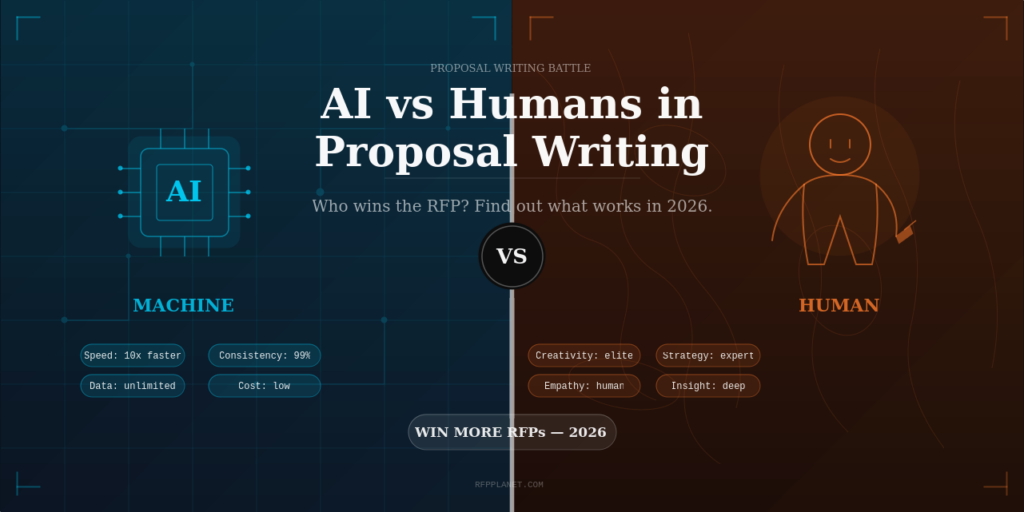
AI vs Humans in Proposal Writing is no longer a theoretical debate. It is a live competitive battle happening inside every government contracting bid team right now.
In 2026, nearly 80% of RFP teams have deployed some form of generative AI – yet the average win rate still sits at just 39%. Something is not adding up.
This guide cuts through the noise with data, real comparisons, and an honest verdict on where AI outperforms human writers – and where human judgment is still the deciding factor between winning and losing a government contract.
Key stats at a glance:
- 80% of RFP teams use AI in 2026 – up 10% year over year
- 39% average proposal win rate despite widespread AI adoption
- 50% of proposals are still rated generic or off-target by evaluators
Table of Contents
- What Changed in 2026: From Generative to Agentic AI
- Head-to-Head: AI vs Humans in Proposal Writing
- Where AI Wins in Proposal Writing
- Where Humans Still Win in Proposal Writing
- What the Win Rate Data Actually Shows
- The Hybrid Model: How Top Teams Combine Both
- The Verdict: Who Should Write Your Next RFP?
- External Resources & Further Reading
- Related RFPPlanet Guides
1. What Changed in 2026: From Generative to Agentic AI
The debate around AI vs Humans in Proposal Writing shifted dramatically in 2026. A year ago, AI meant drafting assistance – you prompted a tool, it wrote a paragraph, you edited and moved on. That is now the baseline, not the competitive edge.
The shift is from Generative AI – which writes text on demand – to Agentic AI. Agentic AI refers to autonomous systems that execute multi-step proposal workflows without a human at each step.
An agentic AI system can retrieve past performance records, match them to RFP evaluation criteria, populate a compliance matrix, flag missing sections, and route the draft for review – all automatically.
According to Inventive AI’s 2026 benchmarks, the primary trend is moving from AI that writes to AI that acts – transforming proposal management from a document task into an automated strategic workflow.
For government contractors, this shift matters because it changes not just how fast you can submit. It changes how many you can submit, how consistently you can hit compliance requirements, and ultimately how often you win.
2. Head-to-Head: AI vs Humans in Proposal Writing
Here is a direct comparison of AI and human performance across the most critical dimensions of RFP proposal writing for government contracts.
| Dimension | AI Performance | Human Performance | Winner |
|---|---|---|---|
| First-draft speed | Minutes per section | Hours per section | AI |
| Compliance checking | Systematic, exhaustive | Prone to fatigue errors | AI |
| Past performance retrieval | Instant from library | Manual, time-consuming | AI |
| Volume scalability | Unlimited, consistent | Limited by team bandwidth | AI |
| Formatting consistency | Perfect every time | Variable across writers | AI |
| Agency relationship intel | Cannot access | Deep contextual knowledge | Human |
| Go/No-Go judgment | Rule-based only | Strategic, intuitive | Human |
| Evaluator psychology | Cannot read unstated cues | Reads between the lines | Human |
| Narrative personalization | Generic without fine-tuning | Contextually nuanced | Human |
| Cost per proposal | Fraction of human cost | High – writer hours + review | AI |
| Overall win rate | – | – | AI + Human together |
The table above makes clear that AI vs Humans in Proposal Writing is not a simple contest. Each side dominates in different areas – and the smartest contractors are using both.
3. Where AI Wins in Proposal Writing
5 Proven Advantages AI Has Over Human Writers in 2026
When evaluating AI vs Humans in Proposal Writing, AI holds a decisive edge in execution speed, consistency, and scale. These are not marginal improvements – they are transformational for high-volume bid teams.
01 – Speed at scale
AI generates a full first draft from RFP requirements in minutes. Human writers typically need 8 to 15 hours for the same output. For teams submitting 166 or more RFPs per year, this is a fundamental throughput advantage that cannot be ignored.
02 – Compliance matrix automation
AI reads the full RFP, extracts every single requirement, and maps each one to a proposal section automatically. Human writers miss requirements under deadline pressure. AI does not fatigue, does not miss items buried on page 47, and does not skip sections under time pressure.
03 – Past performance matching
AI instantly retrieves the most relevant past contracts from your content library and tailors them to the current RFP’s NAICS codes and evaluation criteria. This is a process that takes human writers hours to complete manually – and they still miss the best matches.
04 – Formatting and structure consistency
Page limits, font requirements, section headers, file formats – AI validates all of these before submission. Human writers under deadline frequently miss formatting rules that trigger automatic disqualification. A technically excellent proposal that breaks a formatting rule is still disqualified.
05 – Cost efficiency
AI-assisted proposals cost a fraction of fully human-written proposals. This matters enormously when you are bidding on 100 or more contracts per year and need to allocate limited human expert time to the highest-value opportunities.
According to Loopio’s 2026 RFP Trends Report, AI-first teams complete RFPs 50 to 80% faster than traditional teams and submit an average of 180 bids annually versus the industry average of 166.
4. Where Humans Still Win in Proposal Writing
4 Things Only Human Proposal Writers Can Do in 2026
Despite AI’s speed advantages, the AI vs Humans in Proposal Writing debate is far from settled. There are four critical areas where human expertise remains the decisive competitive differentiator. They all relate to the strategic, relational, and psychological dimensions of winning government contracts.
01 – Agency relationship intelligence
Knowing which program manager prioritizes cost versus technical innovation, understanding an agency’s history with your firm, and reading the political context of a procurement – AI has no access to any of this. The most important competitive intelligence in government contracting lives in human relationships, not databases.
02 – Strategic go/no-go decisions
Deciding whether to bid on an RFP requires assessing incumbent strength, reading the competitive landscape, and judging whether the contract is actually winnable given your current past performance, team availability, and pricing position. AI can apply rules. It cannot exercise strategic judgment.
03 – Nuanced past performance storytelling
Framing your track record in the specific context of what this particular agency values most – and what risks they are most afraid of – requires human insight that goes beyond what a content library contains. The difference between a past performance section that scores 95 and one that scores 70 is almost always the quality of human strategic framing.
04 – Evaluator psychology
The most important information in a government RFP is often what is not written. Unstated preferences, risk tolerances, political pressures, and evaluator priorities that shape scoring but never appear in the RFP document – only experienced human proposal writers can read these signals and write to them.
According to Thalamus AI’s 2026 research, 50% of RFP responses are rated as generic or off-target by evaluators. AI without human strategic oversight produces faster generic proposals. Fast generic proposals still lose.
5. What the Win Rate Data Actually Shows
The data on AI vs Humans in Proposal Writing tells a more nuanced story than most headlines suggest.
The average win rate across all teams is 39%. But this figure masks a significant gap between teams using AI strategically and those using it as a shortcut.
Teams that adopted AI-first platforms are rated as strategic contributors 60% of the time – versus only 47% for traditional teams. They are not just winning more contracts. They are being perceived differently by agency leadership and their own organizational leadership.
The inconvenient truth is this: AI adoption alone does not drive win rates. The teams winning more in 2026 are using AI to eliminate low-value manual work – and redirecting that saved time to the high-value human tasks that actually influence evaluators.
Speed without strategy is still a loss.
According to APMP – the Association of Proposal Management Professionals – the highest-performing proposal teams consistently combine automated first-draft generation with experienced human review focused on evaluator alignment, competitive positioning, and past performance narrative quality.
6. The Hybrid Model: How Top Government Contracting Teams Use Both
The Winning Formula for 2026
The answer to AI vs Humans in Proposal Writing is not a binary choice. The teams consistently winning government contracts in 2026 have built a hybrid workflow that uses each for what it does best.
What AI handles:
- RFP document shredding and requirement extraction
- First-draft generation for all standard sections
- Compliance matrix population and gap flagging
- Past performance retrieval and matching
- Formatting validation and pre-submission checks
- Version control and document management
What humans handle:
- Go/No-go bid decision and competitive assessment
- Agency relationship context and positioning
- Strategic win theme development
- Past performance narrative personalization
- Evaluator-psychology-informed review and editing
- Pricing strategy and value proposition framing
3-Step Hybrid Workflow for Government Contractors
Step 01: AI-first draft
Feed the RFP document into your AI platform. Let it shred requirements, build the compliance matrix, retrieve relevant past performance from your library, and generate section-by-section first drafts. Target completion time: 4 to 6 hours.
Step 02: Human strategic review
Your experienced proposal manager reviews the AI output for evaluator alignment, adds agency relationship context, rewrites win themes, and personalizes the executive summary and past performance section. Target: 6 to 8 hours of focused, high-value human effort.
Step 03: AI final validation
Run the completed proposal back through AI for compliance gap detection, formatting verification, and keyword density checking against the RFP’s evaluation criteria. Submit with confidence that nothing has been missed.
7. The Verdict: Who Should Write Your Next RFP?
After examining all the data on AI vs Humans in Proposal Writing, the verdict is clear: neither AI alone nor humans alone produces the highest win rates in 2026.
AI wins on speed, consistency, volume, and cost. Human writers win on strategy, relationships, personalization, and evaluator insight. Government contracting teams that deploy both in a structured hybrid workflow are outperforming teams that rely on either alone.
The bottom line:
AI will not replace human proposal writers. But proposal writers using AI will replace those who do not. The teams winning the most government contracts in 2026 treat AI as infrastructure – not a shortcut – and invest the time saved into deeper human strategic work that actually influences evaluation scores.
8. External Resources & Further Reading
The following authoritative external resources were used in this analysis of AI vs Humans in Proposal Writing. All links are DoFollow.
- Loopio 2026 RFP Trends & Benchmarks Report – Annual survey of 1,500+ proposal professionals covering win rates, AI adoption, and submission volume data
- Inventive AI – RFP Response Trends 2026 – Agentic AI benchmarks, completion time data, and workflow automation insights
- APMP – Association of Proposal Management Professionals – Industry body for proposal professionals with certifications, best practices, and global research
- SAM.gov – System for Award Management – Official US federal contracting registration and opportunity database
- USASpending.gov – Track who wins US government contracts and at what value
- Thalamus AI – 12 RFP Trends in 2026 – Generative AI to Agentic AI shift, proposal team stress data, win rate analysis
9. Related RFPPlanet Internal Links
- Can Indian Companies Apply for US RFPs? The Proven Ultimate Guide 2026
https://rfpplanet.com/blog/blog-indian-companies-apply-for-us-rfps/ - Proposal Writing Tools & Templates for 2026: Strategic Guide for Business Owners and Startups
https://rfpplanet.com/blog/proposal-writing-tools-2026 - Top 5 Websites to Find RFP Opportunities and Win More Contracts in 2026
https://rfpplanet.com/blog/top-5-websites-to-find-rfp-opportunities - Complete Guide to Choosing the Perfect RFP Vendor
https://rfpplanet.com/blog/rfp-vendor-selection
Ready to Win Your Next Government Contract?
Now that you understand the real dynamic of AI vs Humans in Proposal Writing, the next step is finding the right opportunities to apply this strategy.
The best proposal writing process in the world cannot win a contract you never found. That is where RFPPlanet comes in.
Every day, thousands of active government RFPs are posted across the USA and Canada – covering IT services, consulting, staffing, marketing, healthcare, engineering, and more. Most contractors never see them because they are buried across hundreds of state, federal, and local portals.
RFPPlanet is an AI-powered procurement platform that centralizes government RFPs, bids, tenders, and contract opportunities from federal, state, and local agencies throughout the United States and Canada. Updated daily, it helps your team focus less on searching and more on securing contracts.
Here is what you get with RFPPlanet:
- 🔍 Search AI-based active RFPs by keyword, category, and state
- 📥 Download full RFP documents, submission guidelines, and deadlines
- 🔔 Set daily email alerts so matching RFPs land in your inbox every morning
- 📊 Browse expired RFPs to study past awards and understand what wins
- 🤖 AI-powered search that finds opportunities your competitors miss
Whether you are a solo consultant or a growing government contracting firm, RFPPlanet gives you the competitive intelligence to bid smarter – and win more.
Pricing – Start on RFPPlanet Today
Monthly Subscription – $69/month Unlimited access to live RFPs, deadlines, and submission guidelines.
Yearly Subscription – $699/year Save 20% compared to monthly. Best value for active vendors and growing firms. Includes 3 free RFP downloads.
7-day free trial available. No credit card required. Upgrade or cancel anytime.
Visit rfpplanet.com to browse thousands of active government RFPs updated daily.
Published by RFPPlanet – AI-powered government RFP and bid search for the USA and Canada.